
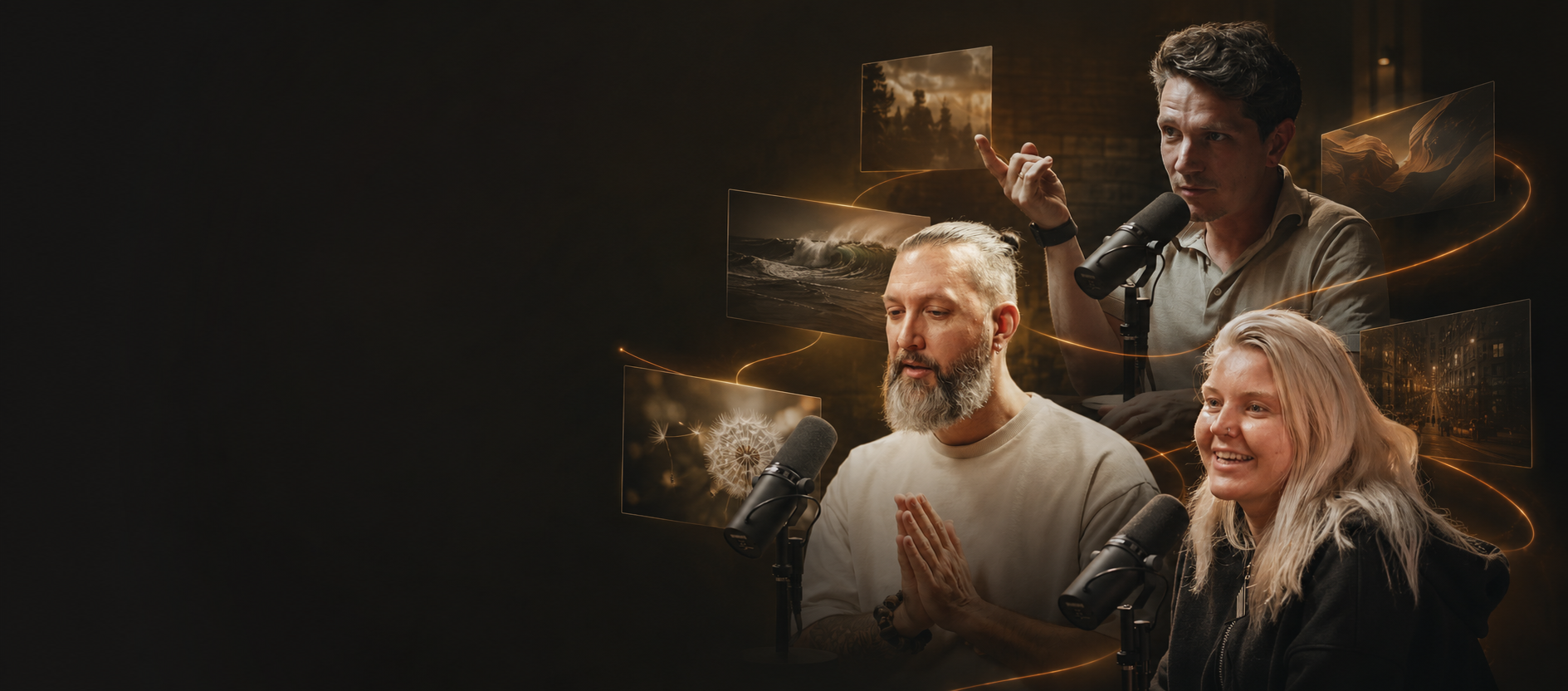
WHY A PODCAST
A podcast gives your expertise somewhere to live.
For founders, experts and businesses who want to move beyond fragmented posts and create conversations with depth, trust and long-term value.
WHY LONG-FORM MATTERS


WHY THIS MATTERS
Clarify what you think
Most people think first and speak later. People who use their voice regularly discover something different: speaking is part of the thinking. A good question makes you choose what matters. Hearing your own answer exposes jargon, borrowed language, contradictions and gaps you could not see on the page.
With repetition, you learn to find the centre of a thought, stay present when challenged and explain complexity without hiding behind it. The audience receives the recording. You leave with sharper thinking, language that sounds like you and a steadier way of showing up in sales, leadership, teaching and everyday conversation.
EXPLORE THE HIDDEN BENEFITS
You hear the gaps
An idea can feel complete while it remains safely inside your head. The moment you explain it to another person, you discover which parts are clear, which parts are assumptions and where the logic still breaks. Speaking gives your thinking resistance, and that resistance makes it stronger.
You find your own language
The first version often sounds like the books, industries or people that influenced you. Repeated conversation slowly removes the borrowed phrases. You find simpler words, better examples and a way of explaining the work that people begin to recognise as yours.
You train your presence
Confidence is not learning to perform certainty. It is learning that you can pause, think, answer an unexpected question, admit complexity and find your way back to the point. That kind of confidence follows you far beyond the microphone.
WHY THIS MATTERS
Let people experience it
Trust based work is difficult to buy from a headline. A podcast gives people time with your judgement, energy and way of explaining. Audio can stay with them while their eyes and hands are busy. Video adds expression, body language and the atmosphere of the room.
The return may be direct, such as an enquiry or sale, or assisted: warmer calls, better fit clients, higher recall, repeat visits, stronger referrals and fewer objections left for the sales conversation. The format does not create those outcomes alone. It gives your thinking more chances to be found, understood and remembered.
LOOK AT THE EVIDENCE
Where attention happens
Podcast attention is not confined to a commute. In Ofcom's 2026 UK study, weekly listeners reported listening while relaxing at home, walking, doing housework and travelling by car. Because people could choose more than one context, these figures show flexibility rather than a single fixed listening place.
Source: Ofcom Audio Report 2026, 1,502 UK weekly podcast listeners. Multiple responses were allowed.
Why the camera matters
Audio and video are no longer separate podcast worlds. They are 2 ways into the same conversation. In the UK, 72% of weekly podcast consumers actively watch podcast video, while 87% still consume audio only podcasts. The overlap matters: video expands discovery without taking away the freedom to listen.
Sources: Edison Research and SSRS, UK Podcast Consumer 2026 and YouTube, February 2025. The formats overlap and the YouTube figure is reported by the platform.
What return can look like
Direct sales are only one form of return. For many businesses, long form content first builds recognition, trust and understanding. The commercial route can then continue through a clip, full episode, website visit, email signup, qualified enquiry and booked project.
These are broader business content benchmarks, not a promise that one podcast will create the same result. Measure the route that matters to your business: meaningful watch time, website visits, email signups, qualified enquiries, referrals and revenue influenced by the material.
Sources: Wistia State of Video 2026 and Content Marketing Institute 2025 B2B benchmark. The CMI study covers content marketing broadly and is mostly North American.
WHY THIS MATTERS
Build your material
Treat the conversation as master material. The complete episode carries depth. Chapters and topic edits help people enter at the right point. Short clips create discovery. A transcript turns spoken knowledge into text that can be edited, searched and reshaped.
The goal is not to flood every channel. It is to extract the ideas worth keeping, choose the formats that serve a real audience and let every smaller piece lead back to the complete thought. Not every output below is included in every package. They are the possibilities contained inside a strong source recording.
WHAT ONE RECORDING CAN BECOME
Watch and listen
- Complete video episodes
- Audio podcast episodes
- Thematic edits and chapters
- Trailers and opening hooks
- Vertical clips, Reels and Shorts
- Medium length topic excerpts
- Audiograms and audio trailers
- Subtitles and captions
- Stills and quote moments
- Thumbnails and cover images
Context: 58% of surveyed B2B marketers rated video among the content types producing their best results, the highest rated format in the 2025 CMI benchmark.
Read and be found
- Edited transcripts
- Show notes and episode summaries
- Dedicated episode pages
- Topic led articles and blogs
- Search focused FAQ answers
- Newsletters and email sequences
- LinkedIn essays and posts
- Quote cards and carousels
- Guides and lead magnets
- Website and landing page material
The transcript is raw material, not the finished SEO page. The stronger route is to shape it around one question your audience genuinely asks, add original examples, clear headings, useful context and a route back to the complete conversation.
Google recommends unique, expert led and useful content. It explicitly states that indexing and ranking are never guaranteed. Read Google's July 2026 guidance.
Sell, teach and reuse
- Sales followups and proposal support
- Founder stories and case studies
- Client testimonials
- Product or service explanations
- Client onboarding resources
- Course and masterclass lessons
- Internal academies and training
- Talks, keynotes and voiceovers
- Recruitment and employer stories
- A structured knowledge archive
Not every recording needs to become everything. The value lies in knowing what the material can become, then producing what the business and its audience will genuinely use.
WHY THIS MATTERS
Build a body of work
A body of work is not simply a large amount of content. It is a deliberately organised record of your questions, ideas, experience and relationships.
The Firestarters Library makes this visible. One conversation belongs to a series. A series reveals recurring themes. Those themes can lead to shorter stories, articles, learning tools and new questions. New work does not replace the old work. It gives it more context.
HOW A LIBRARY COMPOUNDS
Make the thinking navigable
Organise episodes by question, theme, audience or season. Connect related conversations, articles and clips so someone can enter through one useful idea and understand the larger world around it.
A feed asks people to scroll backwards through time. A library gives them a map. That makes the accumulated thinking easier to discover, revisit and share.
Serve people beyond the sale
A useful episode can be shared before a meeting, used during onboarding or sent when a client encounters a familiar problem. Existing clients gain a resource they can search, share and return to. Future clients gain a way to understand the depth of the work before making contact.
The content stops being promotion alone. It becomes part of the service you offer to the people around your business.
Let every piece strengthen the rest
A new episode can revive an older one. A new article can point towards several conversations. A newsletter can reconnect people with a theme recorded months earlier. Over time, recurring ideas can support a framework, course, talk, book or searchable knowledge base.
of hidden B2B decision makers said thought leadership is one of the best ways to understand the calibre of thinking a company is likely to deliver to clients.
Source: 2025 Edelman and LinkedIn B2B Thought Leadership Impact Report, 1,934 US business executives. Thought leadership includes more than podcasts.
INSIDE THE STUDIO SERIES
9 EMAILS 52 DAYS
EMAILS
Before you record anything, understand what a podcast has become.
Here in Flanders, podcast reach changes sharply by age, listening habit and platform. Across 9 short emails, I turn current local audience data and what I have learned hosting Firestarters into practical decisions about your idea, format and distribution.
Use the knowledge whether you record here, somewhere else or with the equipment you already own.
THE MEDIUM HAS ALREADY CHANGED
4 signals from Flanders, measured in late 2025
-
33 percent
of Flemish adults listen to or watch podcasts at least monthly.
imec.digimeter · published 2026 -
21 percent
of Flemish adults listen to or watch podcasts weekly or daily.
imec.digimeter · published 2026 -
55 percent
of Flemish 25 to 34 year olds use podcasts at least monthly.
imec.digimeter · published 2026 -
26 percent
of monthly Flemish podcast users use YouTube as a podcast channel.
imec.digimeter · published 2026
imec.digimeter 2025 surveyed 3,001 Flemish adults from 8 September to 16 November 2025. The 33% and 21% values combine the report’s mutually exclusive monthly, weekly and daily categories. The 55% figure applies to people aged 25 to 34. The 26% figure applies to the 955 respondents who use podcasts at least monthly. These figures describe audience behaviour, not guaranteed business results.
INSIDE THE STUDIO
When the space starts working for you
CLIENT PERSPECTIVE
“The value is not only the recording quality. It is how the environment changes the conversation.”
After building the studio in summer 2025, Alex’s podcast was my first time trying it myself. Sitting in the finished room, I felt the space change the conversation.
One production in practice VayaMassage
One collaboration became a brand film, a full conversation, a client story and a playful short form series.
SWIPE BETWEEN THE BRAND FILM, PODCAST AND CLIENT STORY
Wat als? Short stories with a wink
A playful VayaMassage series with humor as its backbone. Each short gives one idea its own small world.
SWIPE THROUGH THE “WAT ALS?” SERIES